Friday, September 11, 2015

Earning a living

I mentioned something in my post on Social Security and Welfare - that is, that 73% of those who earn welfare are in working families (families with at least one person working a full time job).  There are a few reasons why this might be the case.

Imagine that you are someone who has work experience, has a 4-year degree, but has been out of work for a while.  In your particular town or city, the work you're qualified for either doesn't exist or has too many people working in the field.  You don't have a bad reputation, you just can't get work.

You used unemployment while it was available, and you didn't slack off looking for work during that time, but you still failed to find anything.  Now, those unemployment benefits have run out, and your family is hungry.  During a more prosperous time in your life, you and your spouse had two or three children, but that prosperity dried up.  Now, you have mouths to feed.

Your spouse has similar problems finding work.

What do you do?  You take a job.  Any job.  Anything at all that can help put a roof over your kids' heads, food in their bellies, clothes on their backs. 

So you go to work at a fast food restaurant, and you find a job paying $7.25 an hour.  It's the only thing that's offered.  And so you work.

Working there pays $290/week.  Even the cheap apartment you found costs twice that, so you're left with only about $600 for the entire month to try to get through the month.  Your spouse can't afford to work full time - someone has to be there for the kids, and babysitting or daycare would cost more than your spouse could bring in at minimum wage. 

For reference, it costs about $50/month in clothes, $50/month in healthcare, $100/month in food for each child.  That's the entire monthly budget right there, and we haven't even touched transportation (if your cheap apartment isn't anywhere near your minimum wage job, or if you have to travel to see the doctor or go to the grocery store) or costs associated with education... or, for that matter, what you or your spouse will eat.

Sure, you have qualifications that could rescue you from this lifestyle at some point, when some kind of job opens up.  Until then, though, you're out of luck and out of money. 

This is the sort of situation the vast majority of people receiving government assistance are in.  The abysmal pay of those minimum wage jobs are exactly the reason why they need the government to help lift them up and keep them eating and getting to their jobs (if you thought "they don't need a car, they can use the bus" - congratulations on picking the government-sponsored transportation option), and exactly the reason why the government is now helping get them health insurance to keep those medical costs down and help them stretch their budgets further.

Of course, it costs us all money in the form of taxes.  A tiny amount of money.  For every $1 of taxes you pay, 0.0059% of that dollar is welfare; that is, if you pay $10,000 in taxes, you pay about $59 toward welfare (source).

But if that's too much for you, then perhaps you'd be OK with the alternative.  You see, if people such as I described were earning a reasonable living, then their need for welfare would disappear.  Raising the minimum wage to $15 would increase that person's pay from $290/week to $600/week.  If this person also had no tax burden (with 4 dependents, he or she would likely get 100% of taxes back), that means being ale to pay for everything I described and still have about $300 left for transportation or education (such as putting money back for the kids' college), or for finding a bigger place, like a house where they can actually be saving money in equity rather than throwing it out on rent.

That would take the vast majority of that 73% on welfare and remove them from welfare.  It'd mean decreasing that personal bill from $59 out of $10,000 in taxes to just $16 per $10,000. 

"But that will hurt the economy" you might think.  "Raising the minimum wage will make my hamburger cost more, meaning I'll be making functionally less."  Or, "It'll mean fewer jobs for minimum-wage workers."

All I can offer you there is what 600 economists said about the issue:
In recent years there have been important developments in the academic literature on the effect of increases in the minimum wage on employment, with the weight of evidence now showing that increases in the minimum wage have had little or no negative effect on the employment of minimum-wage workers, even during times of weakness in the labor market. Research suggests that a minimum-wage increase could have a small stimulative effect on the economy as low-wage workers spend their additional earnings, raising demand and job growth, and providing some help on the jobs front. (source, emphasis mine)
Suddenly, those minimum-wage workers would have the money to buy things, such as things from restaurants and department stores where other minimum-wage workers work.  The increase in sales volume would more than make up for the losses such companies would endure paying more to their employees.  While certainly some of the more reprehensible companies (I'm looking at you, Papa John's) will protest and say that they'll have to cut hours or reduce the number of employees, the facts just don't support this at all.

 Join the effort for a nationwide increase in minimum wage today, https://berniesanders.com/

Thursday, September 10, 2015

Real Citizens United

Citizens United.  In lower case, it refers to the very core of democracy - that is, that citizens can unite around common ideals and goals and evince change.  In capital, it refers to two things: an organization and the Supreme Court decision in a case involving that organization.

The organization speaks of itself in ways that seem to uphold the ideals of democracy:
Citizens United is an organization dedicated to restoring our government to citizens' control. Through a combination of education, advocacy, and grass roots organization, Citizens United seeks to reassert the traditional American values of limited government, freedom of enterprise, strong families, and national sovereignty and security. Citizens United's goal is to restore the founding fathers' vision of a free nation, guided by the honesty, common sense, and good will of its citizens. (source)
It starts off sounding great - citizens should be in control of the government, and an organization promoting education, advocacy, and grass roots organization means well-educated citizens engaging in the democratic process.  Everything after that speaks to exactly what their definition of a more perfect union looks like, and it's clear from all of their catch phrases ("traditional American values," "limited government," and so on) that their vision is for a Conservative (with a capital C) America. 

But they revealed a lot more when they went to the Supreme Court in the case Citizens United v. FEC.  In extremely brief detail: the group wanted to run its own political advertising, but the FEC said that violated electioneering law.  The SCOTUS decided that this was a freedom of speech issue, that Citizens United had the freedom to spend money however it wanted in order to support or oppose a candidate. 

The basic idea is that for messages to reach the larger public, they must have financial backing.  As a result, money is a necessary component of speech.  And, if money is a necessary component of speech, then freedom of speech requires freedom of money, or the freedom to spend money without regulation on such speech.

Taken on an ideal level, this is great.  Imagine if a million people gave $30 each to support an idea - that $30,000,000 could buy major advertising time on nationwide networks, and help their message reach millions more. 

Unfortunately, we've seen this become problematic, precisely because different people have wildly different amounts of money.  When one person has $20,000, and another has $20,000,000, the person with the millions has 1000 times as much money and therefore 1000 times as much influence over speech. 

And there are people with $20,000,000,000 - which would give them a million times as much influence over speech.

The result is unprecedented independent spending on elections.  Campaign spending had already been growing rapidly (which led to many attempts in the 90s at Campaign Finance Reform), but in 2010, after the Citizens United decision, it exploded.  OpenSecrets.org estimates that in 2008, independent spending was at $338 million.  Just 4 years later, it surpassed $1 billion.  (source)

In 2008, Liberals accounted for 63% of spending.  In 2012, Conservatives dominated, with 71%.  The increase for Liberals was 50%.  The increase for Conservatives was 540%.

While certainly not all of that 540% can be attributed to wealthy donors, the majority of it can - $412 million of the $720 million spend on the election by Conservatives was from the Koch brothers.


To a certain and very limited extent, this is actually a good thing.  After all, despite the Kochs dropping so much on the election, Obama still won.  Thus, their money was "wasted" on their ultimate goal, but did serve society by reentering society.  Their spending went into the coffers of major media organizations, which spent that money, etc. on down the line.  It was one of the few times that trickle-down economics actually trickled.

That said, such money only gets spent in "Battleground" states - states where the money might sway public opinion.  Oklahoma is not such a state, and receives little of the resulting money.

Time Magazine offers a state-by-state breakdown.  Their figures show that Oklahoma received a measly 0.435% of the total campaign expenditures in 2012 (despite having 1% of the national population). 

The goal of the Supreme Court in the decision was making speech more free, and, ironically, they ended up further restricting it.

Think about the last time you went to a loud rock concert or nightclub, and how you had to shout to be overheard by the person right next to you, let alone the person across the table.  That's the effect of unlimited campaign spending.  Those with billions to throw at campaigns are the ones on stage, blasting their message as loud and obnoxiously as possible, while the rest of us are left desperately shouting at each other in an attempt to be heard.

Certainly, sometimes our message gets through to one or two people, but no one else in the room can possibly hear it.  That's always been a problem with free speech, especially with a free media as well - the media can choose whose voices to promote and whose to repress - but now the media's choice is between those willing to spend billions on advertising and those who cannot.  And, that's really a false choice, because no one chooses to lose that kind of money.

This might be fine, if the messages promoted by the wealthy were messages that benefited all of us.  Sadly, that's not the case.  As I've pointed out previously, our incomes haven't been rising.  The Koch Brothers, however, have been making bank:

http://thinkprogress.org/climate/2011/09/22/325612/denier-koch-brothers-worth-50-billion-richest-americans/

Which is exactly what Donald Trump said about money in politics:
“I will tell you that our system is broken,” Trump said on stage in Thursday's GOP candidates' debate. “I gave to many people before this -- before two months ago I was a businessman. I give to everybody. When they call, I give. And you know what, when I need something from them two years later, three years later, I call them. They are there for me. That's a broken system.” (source)

If we want a free democracy, we need to remove big money from politics, thus returning power to all the people, not just the richest among us.  Whether you're a Democrat or a Republican, you should be able to see how the system is rigged against you by this decision.  There are nominally only two politicians running who are fighting back against this system - Donald Trump and Bernie Sanders.  Trump is already one of the richest Americans, so he's an insider of the very system he's working against.  Sanders is more an average guy - worth enough to be upper-middle-class, certainly, perhaps even upper class, but not worth much more than that.  He is, in fact, the poorest person in the U.S. Senate

That's one of the things that makes him different, and his grassroots organization, which has avoided PAC funding, is proof that he can organize people and raise money without relying on the Citizens United decision.  He's our best bet for getting it overturned.

But he needs your help. 

Go to https://berniesanders.com/ today to volunteer and help spread his message.  Let's put an end to unlimited campaign spending by rich people seeking to get richer by buying the government.  Let's make government work for all of us.  It's good for America.  It's good for Oklahoma.

Tuesday, September 1, 2015

Social Security and Welfare

Saw a copy of the following running around on Facebook this week:
From Sodahead

This makes a few claims:
  1. That Social Security and Welfare are similar.
  2. Social Security is in danger of running out of money.
  3. Welfare isn't.
  4. That Social Security is only received by those who worked for it.
  5. That Welfare is only received by those who don't work at all. 
  6. It's right for people who worked for money to receive benefits.
Let's address them one at a time:

SOCIAL SECURITY
Social Security is run by the Social Security Administration, an independent agency within the government.  Its website explains that it "is financed through a dedicated payroll tax" of 12.4% of your income, half of which is paid by your employer if you are not self-employed (source). Only your income up to $118,500 is taxed in this way - anything above that is tax-free, meaning that someone earning $1,000,000 per year is paying an effective tax of 1.47%.

Social security benefits are determined as follows:
We base Social Security benefits on your lifetime earnings. We adjust or “index” your actual earnings to account for changes in average wages since the year the earnings were received. Then Social security calculates your average indexed monthly earnings during the 35 years in which you earned the most. We apply a formula to these earnings and arrive at your basic benefit, or “primary insurance amount.” This is how much you would receive at your full retirement age—65 or older, depending on your date of birth. (source)
So, someone who works *ever* - such as someone who works for two years and then quits (explained below), to retire, go on medical leave, disability, etc - is eligible for benefits.  The amount of the benefits are determined by how much the person puts into the system.

Retirement age was raised a few years back so that anyone born after 1960 cannot retire until 67 to receive full benefits.  (Interestingly, if you work until 70, you can earn more per year - quite substantially more, in fact.  For me, it'd be almost 25% more.)

Social Security also pays disability or death benefits.  When someone dies and leaves behind minor children, those children (and their remaining parent) earn a very significant amount of money (more combined than if the dearly departed had gone on disability, and disability is roughly equivalent to retiring at full retirement age) until the child is 18.

Before we get into "Welfare," I'd also like to throw in Medicare, since that is funded in a similar manner as Social Security.  It's a flat 2.9% (half for employer, as above); however, Medicare *has no cap*.  This will become important to the discussion later.


WELFARE
When we speak of Welfare as a thing different from Medicare or Social Security, we refer to 77 separate programs providing a variety of assistance - from food programs (such as SNAP benefits and school lunch programs) to housing (most notably HUD), to education (Pell Grants, Even Start, Title One, and so on), to medical (most notably Medicaid), to child care (notably Head Start), to community development, and on and on.

What we imagine, however, is something a bit different: an organization within the government that is tasked with handing out a 700 billion dollar chunk of cash, that looks for people who are not working at all and pays them to stay at home and pop out babies.  If this department exists, it exists as Temporary Assistance for Needy Families (or TANF).

That imagery - and specifically the idea of the "Welfare Mother" who was predominantly black and single, and who had kids just to earn money on welfare without having to work - was a big part of the 1990s welfare reform movement that culminated in the 1996 Personal Responsibility and Work Opportunity Reconciliation Act, which reformed the branch of welfare known now as TANF (formerly Aid to Families with Dependent Children, or AFDC).

Of that 700 billion the federal government spends annually on Welfare programs not counting Medicare and Social Security, less than 7 billion, or less than 1%, goes into TANF.  (States pay a roughly equal amount into the program.)  This comes out of the general tax and is determined by the federal budget - meaning that Congress has complete control over how much is put into this and other Welfare programs each year, and the revenue stream is not dedicated.

TANF is notably temporary; that is, it lasts for a maximum of 2 years at a time, and up to 5 years over a lifetime.  No one who is earning it is staying at home for their entire lives farming TANF.

Even if they were, which they're clearly not, TANF's maximum payout is abysmal.  Last year, the Congressional Research Service put out a report titled Temporary Assistance for Needy Families (TANF): Eligibility and Benefit Amounts in State TANF Cash Assistance Programs.  You don't need to read the mere 31 pages of awesomeness - the abstract alone is a gold mine.  It explains the problem with maximum benefits:
In July 2012, the state with the lowest maximum benefit paid to a family consisting of a single parent and two children was Mississippi, with a benefit of $170 per month (11% of poverty-level income). Among the contiguous 48 states and the District of Columbia, the highest maximum benefit was paid in New York: $770 per month for a single parent of two children in New York City (48% of poverty-level income). The benefit for such a family in the median state (North Dakota, whose maximum benefit ranked 26th among the 50 states and District of Columbia), was $427, a benefit amount that represented 27% of monthly poverty-level income in 2012. TANF maximum benefits vary greatly by state; there is also a very apparent regional pattern to benefit amounts. States in the South tend to have the lowest benefit payments; states in the Northeast have the highest benefits.
$170 per month.  And, while such a person is also eligible to receive some other limited benefits (HUD benefits to provide Section 8 housing, SNAP benefits to provide some food), such a person is still far below the poverty line, and definitely struggling to earn enough to keep children in clothes, much less fed and secure enough to do well in school.


So, what's the bottom line for #1? 
Social Security is a social welfare program, but it is not similar to TANF or any other welfare program besides Medicare.  It relies on a dedicated funding stream, and provides benefits for much longer periods of time than other social programs.


Social Security is running out of money:
Social Security has several problems; notably:
  • People are living longer.
  • Baby boomers are in their retirement years.
  • Richer people are earning more.
People are living longer
This graph shows how life expectancy in the US has increased from 1960 to 2013.  In 1960, it was roughly 70.  That meant that the average person could expect to die 5 years after he or she started to receive social security benefits, so those benefits only had to be paid out for 5 years (on average).  Today, it's almost 79.  Even with the increase in the age at which people start receiving benefits (to 67), that's 12 years of benefits - an increase of 240%.

Baby Boomers are retired
Baby Boomers are those people who were born shortly after WWII, when soldiers returned home from war and celebrated by avoiding being celibate.  Birth rates since have somewhat declined, as shown by this graph.

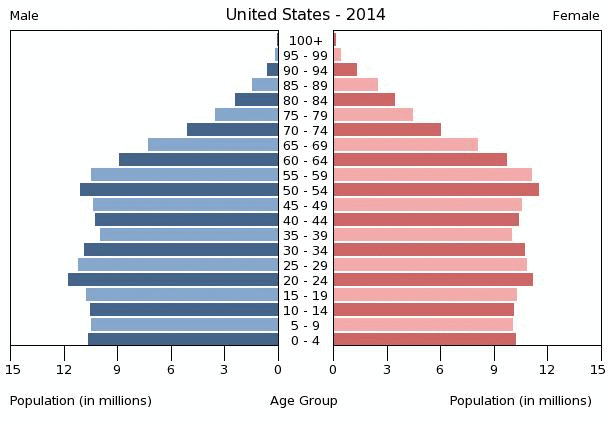
We normally expect age distribution to be somewhat exponential - with a greater number of children than the number of adults producing them.  That is not, however, what we see:

http://www.indexmundi.com/united_states/age_structure.html

While the top of the curve looks like we expect, it's largely to do with how quickly people die off as they get older.  Consider, though, that in that chart, almost everyone over 65 is receiving social security benefits - to the tune of 56 million people today. 

The rich are getting richer
Meanwhile, income hasn't substantially increased for the majority of Americans.  Wages have remained basically stagnant for the last 40 years for the bottom 60% of earners:

Originally from U.S. Congress Joint Economic Committee, reposted on Real-World Economics Review Blog.
Meanwhile, as is clear from that graph, the top 20% are earning quite a lot (and as I'm sure you've heard, the growth for the top 1% has been massive).

This isn't a gripe about income disparity; rather, it affects Social Security along with the other two points.

Social Security is a kind of pyramid scheme.  When you pay into the system, you aren't putting money away for your own future - rather, that money is going to pay for the Social Security benefits of people currently receiving them.  For Social Security to be successful, it requires two things: growing population and growing wealth.  These two things mean more money coming in than going out.  But when population is distributed the way it is now, the system becomes top-heavy, with too many people receiving funds.

This would be fine if income was also growing. It's the multiplication of people times per capita income that tells us how much income is getting taxed.  If income grows substantially, then population doesn't have to.

And income is growing substantially, but only for those already earning more than the maximum taxable amount.  Take a look at that chart again, and you'll see that the top line - the top quintile - on average has earned more than the maximum taxable rate the entire time, and it's the line that has been substantially growing.  All of the big income gains we've made haven't helped Social Security one jot.

It's for this reason that Bernie Sanders is calling for an end to the tax cap.  As I hope you can see, it's very much needed.  The alternative is to continue raising the Social Security tax rate, or the eligible age, or both (as we've done several times in the past).


Welfare isn't running out of money
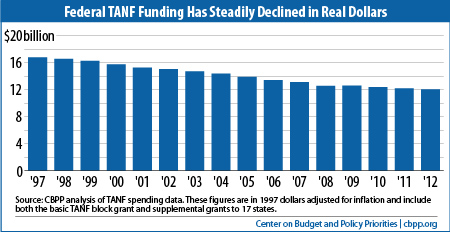
Welfare works, as noted, quite a bit differently.  The 700 billion that funds non-SSA, non-Medicare welfare programs comes out of the general federal budget, rather than a dedicated revenue stream.  For this reason, it's dependent upon the whims of Congress each year.  While many welfare programs have grown in size and budget over the past 50 years, TANF - the one I mentioned earlier is the one we really think of when we think of welfare, has shrunk:

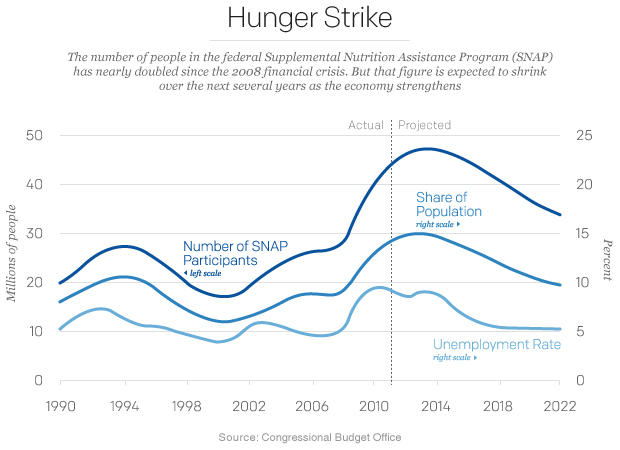
Meanwhile, Food Stamps and Medicaid have grown:
Source
Source
The 2008 economic downturn caused dramatic growth in the number of people seeking benefits - growth that far outpaced budget.  SNAP benefits had to be dramatically reduced as a result.  So, when we say "Welfare never runs out" - that's not quite true.  That said, it's theoretically easier for Congress to raise taxes and increase welfare spending than for it to change how Social Security works.  It just depends on who is in control of Congress as to whether or not that happens:
USGovernmentSpending.com

Do people who receive Social Security earn it?
Well, that depends on your definition of "earn," but using what I imagine the proponents of the progenitor argument would say is "receive in due course as a result of working and paying into the system."

If that's their definition, then the answer is "sort of."

You have to have done some work to receive Social Security.  That's because Social Security also pays out for disability and death.  In both cases, you may be able to qualify with a surprisingly small number of work hours.  Age and situation play into it a lot, but a "worst case" would be for someone under the age of 24 who becomes disabled.  Such a person only needed to earn 6 "credits."  Credits are a special system Social Security uses to determine eligibility:
In 2015 ... you earn one credit for each $1,220 of wages or self-employment income. When you've earned $4,880, you've earned your four credits for the year. (source)
That's only 673 hours of work at minimum wage (you get about 2080 in a full time year).  You can only get 4 credits per year, so such a person would've needed to work at least 337 hours in a previous year.

That's relatively easy to achieve.  Even in the best case scenario of someone who became disabled at age 62, such a person only needed to put in 4 credits a year for 10 years (source).

Sure, the benefits might not be much.  Someone aged 20 who goes on disability right now and earned only $7500 in the last 3 years would get $187 monthly, or $2,244 yearly (per the online calculator). But that's yearly for life - so if that person lives another 55 years, he or she will receive over $100,000 - well in excess of the amount paid in.

And the Social Security Administration estimates that 25% of people will become disabled at some point before retirement (source).

Do people who receive Welfare earn it?
Using the same definition of "earn" as above, the answer is still "sort of."  The difference in terms of "earning it" between welfare programs other than Social Security and Social Security is that the funding source isn't dedicated - that is, you don't pay into a fund and get guaranteed payout as a result.

But it's a mistake to think that people on Welfare haven't worked.

According to a report jointly from UC Berkeley's Center for Labor Research and Education and the University of Illinois at Urbana-Champaign's Department of Urban & Regional Planning, "Nearly three-quarters (73 percent) of enrollments in America’s major public benefits programs are from working families" (source).  They appear to be counting among those programs the Earned Income Tax Credit (EITC), SNAP, TANF, and Medicaid.

You might say, "well fine, that means 27 percent didn't."  But among those 27%, we don't know the story - it's possible such people are disabled like in the SSA estimates.  It's possible they're on unemployment and just waiting for something to come in.  According to the likely-biased (though they claim none) Center on Budget and Policy Priorities, "more than 90 percent of the benefit dollars that entitlement and other mandatory programs spend go to assist people who are elderly, seriously disabled, or members of working households — not to able-bodied, working-age Americans who choose not to work" (source).  Just looking at SNAP benefits, they estimate that 82% of households had at least someone working in the past year (source).

Sadly, better statistics on this subject are not available.

But, just from these, it seems a false narrative to say that people on welfare don't work - rather, the vast majority do work, but are paid abysmally.

It's right for people who worked to receive benefits.
I agree.  That's why I support welfare.  However, it is true that welfare helps keep people in dependency - not because of welfare, but because corporations are abusing welfare to get out of having to pay livable wages.  If you believe that welfare causes dependency, then you should support increasing minimum wage to help pull people out of that dependency.

If not, then you're just a horrible person.

Tuesday, August 18, 2015

Just watch this

Just watch this.  I tried to come up with something to add to it, but I've got nothing.


It is NSFW.

Wednesday, August 12, 2015

The Illusion of Paradox

There are two concepts I want to talk about - the Paradox of Choice, and the Illusion of Choice.

In 2004, Barry Schwartz released a book titled "The Paradox of Choice: Why More is Less."  If you haven't heard about it, the general theory of it goes like this: People like having choices, and like having more choices available to them, but when they are actually tasked with choosing between those things, they have a harder time choosing, they take longer doing it, they evaluate it on completely irrelevant data (rather than things that matter), and they are less-satisfied with their choice later (source 1, source 2).  In a recent follow-up to address some discrepancies in the theory (the paradox is not always true, it just really depends on the specific scenario, and no one knows why), Schwartz offers an examples:
a large retailer of office supplies reduced the number of options offered in its print catalog in many product categories. It did this not because of the research on too much choice, but to save money on production and postage. It assumed that the change would lead to reduced sales, but hoped that production and distribution savings would outpace sales losses. What the company found was that in virtually every category in which options had been reduced, sales increased. (source)
You can visit that link to read more about it.

The Illusion of Choice, by contrast, is this concept that you have a choice when you really don't.  There's a famous "intellectual" joke that features this:
Jean-Paul Sartre is sitting at a French cafe, revising his draft of Being and Nothingness. He says to the waitress, "I’d like a cup of coffee, please, with no cream." The waitress replies, "I’m sorry, Monsieur, but we’re out of cream. How about with no milk?"
Part of this joke has to do with the illusion of choice - that is, when the waitress is out of cream, Sartre can't meaningfully make the choice between cream and no cream; therefore, she offers him the drink without milk, so that he can make the choice (interestingly, since Sartre believes nothing is something, the decision is really between the inability to choose and the ability to choose, which is itself a choice... ok my brain is hurting now).

For another example, let's say you know that the vending machine regularly carries bottles of water, and you would like one.  You hit the button for water after paying money in, but nothing drops, and the screen on the machine says that it's out of stock.  You seemingly had a choice between paying for water or drinking from a fountain; then, you had the choice between water and anything else, but that choice was just an illusion.

The Illusion of Choice is also present when two things seem different but are arguably not.  Let's go back to the vending machine example: let's say that it's also impossible to get a refund, so now you're left with a choice between sodas.  All of them are loaded with sugar or artificial sweeteners, so your choice of which drink to get is merely between different types of junk.  The drinks are all arguably the same, and are certainly the same from a health perspective.  The choice between them is a false one - which one you select doesn't matter.

Definitions out of the way?  Good.  Let's move on...


Several years ago, I noticed that there were some issues regarding Paradox and Illusion with regard to online dating, and wrote a lengthy blog post on OKCupid which has since been deleted.  In essence, it went like this:

In online dating, you have the ability to select very discreet feature about your potential partner: a range of heights, sometimes a range of weights or self-selected body types, eye color, hair color, smoking habits, drinking habits, religion, political alliance, kids, location, marital status, sexual orientation, and so on.  It feels like you're building a person at a car dealership, selecting the options you'd like to add on. Each one of these things is a choice, and although you can certainly choose "all" for many of them, by offering the option to choose, and by further returning results for those options, it feels like the choices are meaningful (the choices are real and not illusionary) and rational.  It leads to a feeling of self-importance, since you have the power to make such choices, and to a feeling that if you relax any of those choices, you're "settling."

And then, once you have all of these choices defined and you do a search, if your settings are too relaxed, you get a ton of matches.  All of these matches represent a choice you have to make - whether or not to reach out to a person, whether or not to respond if they message you, and whether or not to block them entirely, removing them from your list so you never have to see them again.

And here is where the Paradox of Choice comes into play - because we have all of these potential matches, but we have perhaps too many.  It can lead us to backing away from the choice rather than making it, and when we do make it, in making it based on entirely irrelevant criteria.

Case in point: when my wife first messaged me on a dating site, before we started dating of course, I had to evaluate her profile and her message to me to see if I would be interested, and it was certainly possible that evaluation would've led me to turn her down, because her grammar was not perfect (and in the past I had demanded grammatical perfection) and she was divorced (I had wanted to meet someone who had never married).

Thankfully, because I had realized the effect that the Paradox of Choice had made on my dating life, I had decided it was necessary to relax my ideas about what I need to find in a partner.  It took a long time (I had written that article more than a year before we met), but by the time she sent that message, I had at least gotten to the point where I could say "well, this isn't really that important."  And those things aren't.  I clearly have thrown grammar out the window now, as you can certainly tell from my willingness to begin a sentence with a conjunction, and I also realized that someone's marital status wasn't always an injunction on that person's ability to make good decisions or that person's ability to follow-through on promises, and rather that it varied from person to person.

I decided to write her back, and a few days later we got together for a First Friday down at the Guthrie Green, and though the date should've been the worst date ever based on how much we both disliked the art we encountered, we both had a blast.  I knew before the night was out that I wanted to spend a lot more time with this woman, and it's a decision I'm happy I made.  Fortunately for me, she made the same choice.

So yes, this is a call to throw away those illusionary choices for what they are, and try to meet random people.  You never know what will click.  The same is true for clothes - try them all on, because even though yellow might not normally be your color (it's not anyone's color), maybe this particular shirt or dress or whatever will look amazing.

Try on everything.

That said...

The Paradox of Choice also comes into play in a lot of other areas of our lives.  One of the great benefits (to corporations) of the ways in which we shut down when presented with many options is that once we make a choice, we tend to stick with it forever.  That is, if we choose to eat at McDonald's, we'll choose to eat there all the time.  Evaluate your own eating habits, and I bet when you eat out you eat at a fairly narrow range of restaurants.  You may have your special date night restaurants (places you've never been before possibly, but maybe expensive favorites.  Mine is Ti Amo.), but you probably also have places you frequent, such as Starbucks, Panera, Arby's, and so on.

Thus, you're presented with both a Paradox of Choice (too many choices preventing you from making a choice at all) and an Illusion of Choice (because when you finally go there, you'll look at the menu meaningfully and choose from a much smaller subset of dishes you normally go with anyway).

It also comes into play with politics...

You knew I'd get here eventually...

The Republican presidential field suffers both from the Illusion of Choice and the Paradox of Choice - that is, there are so many candidates that you can't possibly learn everything about every one of them, and attempting to do so can prevent you from making a meaningful decision, but it's also an Illusion of Choice because the candidates are all functionally the same.

To illustrate this, I used data from http://presidential-candidates.insidegov.com/ to put together a chart of how well the candidates toe the party line.  The site simply gives the candidates a "Supports," "Opposes," or "Neutral/No Opinion" position as a distillation of their views, which may or may not be accurate (any simplification is always an error, as a person's views are complex), but which may be helpful to illustrate the point.

Across 18 different categories, candidates toed the party line 76% of the time.  The two "questionable" categories were "Women and Minority Rights" (which really shouldn't get wrapped up into one column) and "campaign finance reform."  Both of these are highly subjective, in that someone can say they support women's rights and yet vote against women's rights in every case, and can say they're in favor of campaign finance reform yet side with the Citizens United decision (case in point: Rand Paul, who has said "I agree with Citizens United").

Another questionable category is "Immigration Reform."  A person can be in favor of reform in that he or she could be wanting to make immigration harder.  Yet the site only gives a "supports" or "opposes," so it's hard to say what that really means.

Even with these problems, the chart is frighteningly red.  The biggest exception is Chris Christie, a man who single-handedly skews the chart 2 percentage points toward the left.  He's tallied as "supports" for same sex rights, despite vetoing a New Jersey bill that would have legalized it.  He's tallied as "supports" for "Peace and Diplomacy," yet does not support the current Iran nuclear deal

In the end, what we're left with is that in a large number of cases, Republican candidates are either completely right or just leaning right, and even when they lean left on an issue, it's only just. 

What does this mean?  That any choice between Republican candidates is, for the most part, a choice between personalities alone, rather than on beliefs. 

This is largely why Donald Trump is currently in the lead by a large margin - because in a field of similar voices, his is the only one able to rise above the tide by pure virtue of his personality.

This lead will one day end.  The way of primaries is to narrow the field.  He might win the first few by a large margin, but those first few primaries will serve to push out those people who have no chance of winning the election.  As the field narrows to five or six people, suddenly the din of voices will diminish, and people will be able to engage with the personalities of other candidates.  At some point in the process, someone will rise above the crush and appear to be sane by Trump's insanity, and the result is that Republican votes will flock to him.  This is likely to be Jeb Bush or Scott Walker - two people who represent the farthest right the party can go.

And here's where this whole thing comes to a head.  Eventually, we'll have the simple choice between a Republican candidate and a Democratic candidate.  Though this is likely to be Bush vs Clinton, it's entirely possible it could be Walker vs. Bernie Sanders.  But the paralysis that comes thanks to the Paradox of Choice present on the right could prevent less-engaged voters from participating, and less-engaged voters are often younger voters who lean heavily left.

Which will result in a landslide Republican victory, even when polls will indicate that the Democrat is ahead by several digits. 

The answer, fortunately, is not to fight fire with fire (running 20 Democrats), but rather the huge cult of popularity that's forming around Bernie Sanders.  If he can keep up his momentum, his voice rising easily above the voices of the right, he might just have a shot at winning.  He has the ability to fire up young voters in ways that other candidates haven't been able to, and that's exactly what it will take.

Thursday, August 6, 2015

Soylent Green

Ok, so I think I'm finally ready to weigh in on the controversy surrounding Planned Parenthood and the selling of aborted fetus tissue.  Fortunately, PolitiFact has weighed in on this.  It turns out that while it is illegal to sell such tissue, it is perfectly legal to donate it for a fee - a fee that is meant to recoup the losses of storage, transport, and so on.  So, even if PP is donating for a fee, it's still not breaking the law, assuming that the fee is "reasonable" (and we'd have to do a lot of accounting to determine whether that's the case or not).

So, at issue is not whether it's legal, but whether it's moral.  The question started out as "should Planned Parenthood be profiting off of such tissue," but as PolitiFact notes, they're not profiting:
"The amounts she cites do not appear to be out of the ordinary, but no one knows because there is no registry or compendium of fees charged by organizations (or) institutions supplying fetal tissue," said Arthur Caplan, director of the Division of Medical Ethics at New York University’s Langone Medical Center. "When she haggles about fees, that does not appear to me to be trying to profit."
But it also seems wrong for Planned Parenthood to profit from abortions because of the inherent belief that abortions are bad.  Ergo, if they're able to sell fetus tissue at a profit, it's in their best interests to try to abort as many babies as possible, rather than try to provide alternatives to abortion (such as prevention, parenting, and adoption assistance).  It would represent a conflict of interest.

But we know that this all hinges upon this inherent belief in the immorality of abortions because we don't have the same arguments against similar conflicts of interest in other arenas.  For instance, hospitals have the same guidelines, and can donate aborted fetus tissue or human cadavers of all age, with similar fee requirements.  We don't question their ability to do so, because we recognize that there's a valid medical need for it - namely, that scientists and medical students might be able to use the bodies for study.

Which raises the question: what do the people angry at Planned Parenthood think PP is doing with these fetuses?

Again, this comes down to the issue of "us vs them" or self vs other that I've talked about before.  On the right, there is a constant campaign to smear Planned Parenthood and other providers of abortion and abortion-related services as monsters who are out to murder babies.  And when you vilify an "other" in that way, it's easy to imagine the other as capable of any number of atrocities.

Sure, they may not say that Planned Parenthood is grinding up fetuses and turning them into food and food-fillers for our fast food industry, but they're also not saying that they're donating them to research.  By leaving the question open, and by filling the minds of those listening with monstrous ideas, their minds fill in such horrible ideas as "what ifs."  

Wednesday, August 5, 2015

What I Used to Believe about Abortions

Senator James Lankford (R-idiculous) set off some controversy by arguing that abortion is a men's rights issue, which of course was immediately pounced on by just about everyone.  It reminded me, though, of some things I used to believe about abortion, and so I thought I'd share some conservative arguments from my past that go beyond simple Biblical arguments (which I already dissected in my last post, Unplanned).

First of all, let's talk about the men's rights argument goes.  Basically,
  • I had something to do with the pregnancy, too.
  • The sperm involved in creating the embryo is an extension of my body.
  • The embryo is therefore 50% mine, and 50% her's.
  • And since it is equally mine, I should have an equal say in what happens to it.
Which would be a perfectly fine argument if the embryo was being grown in a Petri dish (and if you accept that "mine" doesn't imply property ownership but legal responsibility).  If it was being grown outside of a human being, and if women's eggs could be harvested as easily as male sperm, then the effort put into creating the embryo would be truly 50/50 on the part of the biological progenitors and all of the work would be on the doctors and scientists tasked with successfully growing it to viability.

Of course, that's not what happens except in perhaps one out of every billion or so births, so the argument then proceeds that the role of women in the process must be questioned.

There is a song that came out in 1998 by Everlast called "What It's Like."


The basic premise of the song is that you really have to be in the same situation as someone else to understand "what it's like" to be stuck making the choices that person is having to make.  It tells three stories in between the choruses, and I liked the first and the third easily enough, but the second I mocked.  That story goes like this:
Mary got pregnant from a kid named Tom who said he was in love
He said, "Don't worry about a thing, baby doll, I'm the man you've been dreamin' of."
But three months later he said he won't date her or return her call
And she sweared, "God damn if I find that man I'm cuttin' off his balls."
And then she heads for the clinic and she gets some static walkin' through the door.
They call her a killer, and they call her a sinner, and they call her a whore.  (source)
And my mocking basically called her a dumb bitch for believing Tom, and saying it was all her fault for getting pregnant.  I wholeheartedly agreed with those who were expressed in the last line, calling her a killer, sinner, and whore.

To summarize what leads to this idea,
  • When a woman gets pregnant, it's her fault.  She is responsible for birth control, responsible for declining or accepting sex based on whether or not she would like to get pregnant, and responsible for being able to resist force or coercion, no matter her age.  
  • If she slips up on any of these points, she's irresponsible, and should therefore be given more responsibility by forcing her to care for an infant she does not want.  
  • Meanwhile, the man should be forced to provide care for the infant, even if that means that the man should be forced back into the woman's life, even if she does not desire that (such as if she was raped or if the man turned out to be an ass who no one would want in the child's life).
I didn't place fault in the hypothetical Tom for failing to wear a condom, or for running the other way.  That's just how a man sometimes behaves.

My favorite line to say in those days was this:
I'm pro-choice, I just believe that the choice was made the day the woman had sex.  She already chose to have the kid.
Which is an awfully easy way of looking at the world.  If every woman actually had that choice, then perhaps that would be a fair way to see things.  It's hopelessly optimistic about the power available to women in this day and age, even while it reflects a willingness to grant men the power to spew their progeny far and wide without repercussions. 

It was, therefore, when I realized that choices could be considerably more complicated than that that I changed my opinion.  I had already accepted rape and incest as valid reasons to get abortions, even though I didn't like it, because of the belief that women should have at least that much control of what happens to them.  But then I started thinking about hypothetical situations, and imagined a woman who had been raped by someone who she didn't feel she could report, for whatever reason - perhaps because the shock of rape by someone she was so close to her left her struggling with complex emotions she had to spend time struggling to work out.  Should this woman be denied access to an abortion, knowing full well that she hadn't dealt with the emotions yet that would enable her to be a fit parent, and knowing that she was raped and therefore hadn't had a choice? 

The answer was a resounding "no," of course.  But, if abortion was only available in the case of rape or incest, then she wouldn't be able to have one unless she either drummed up the courage to report it or she was legally compelled to report it - that is, her report is forced out of her.  Forcing a woman to do anything, especially after she has been a victim of force, seems cruel and unusual.  The resulting realization is that abortion has to be legal just because we can't know the circumstances that led the woman to that place.  We don't have to like abortion to still consider it necessary. 

(and to the haters who say "well, you're describing an extremely weak woman, that's a very negative view of women," I say, "perhaps, but I was a fledgling liberal at that time, so it's certainly possible I still held some negative views of women from my days arguing against abortion rights."  But, I have also since met a woman who had exactly the story I describe above.  I won't name names, and I won't share details of her story.)