I already talked here and here about the issue of gay marriage, but I felt the need to add a few words on the historic occasion of the Supreme Court's decision to overturn gay marriage bans.
My initial thought was: I can't believe it, that's awesome. I had not thought they would, since so many on the Supreme Court are conservative, though yesterday's ACA decision certainly gave me a bit of hope.
I later thought, however, that it's only a small piece of the puzzle. Gay marriage and the ACA are tiny pieces of a larger social justice agenda, but they're pieces that had an incredibly large voice. They were things that, even though the Republicans fought against them mercilessly, seemed like they were destined to pass, that the movement in America is toward those avenues of equality, and any struggle against them was just a token gesture.
The real problem behind all of it is a more nebulous quagmire of wealthism, a need to pit the middle class against the lower class so that neither can rise up against the upper class.
and I'm a bit afraid... afraid that when these two issues are considered resolved by most people, they'll give up on politics, they'll leave politics in the hands of those who have effectively limited the right to free speech to the wealthiest corporations, who have denied the right to vote to millions, who have reworked voting districts so that their political party is the dominant one in Washington even when they represent the smaller number of citizens.
Those of us who still have the right to vote must stand up to these measures, must recognize that the victory at the Supreme Court today is just the first little skirmish in a much longer and war, and must train and arm and mobilize to fight that war, not with guns but with votes and words and capital.
Voting for Bernie Sanders in the general election would help, but it's not enough. We need constitutional amendments to fight gerrymandering and voter restriction and especially, first and foremost, Citizens United.
Friday, June 26, 2015

Thursday, June 25, 2015
Interpreting the law
I got in an argument with one of my coworkers today over the Obamacare ruling issued today. For those who have somehow kept their heads in the sand about it, the ruling is basically this: The Affordable Care Act offers tax credits for those who enrolled in exchanges - some of which are established by states, and some of which by the Secretary of Health and Human Services. However, because the way the law is worded, it appears to only specify that those who enrolled in exchanges established by the state should get those tax credits, and everyone else is out of luck.
Obama argued that the law was clearly meant to include those who enrolled in secretary-established exchanges, while his opposition argued that if that's what the law meant, it would be in the law.
My colleague argued that as well - that we have to read the law exactly as it is written.
So I asked him this:
Let's say I take this toy football off your desk, and I keep it. You interpret my action as theft as you understand the law, and call the cops. They come, take your statement and mine, and based on their understanding of the law, they arrest me. They pass the case to the district attorney, who again has to make an interpretation of the law to decide if it's reasonable to try the case in a court, as well as ensuring they have enough evidence. When it gets to court, our two lawyers will get up and argue about the case - and their argument will have to sway the judge and jury to one side or the other. The jury won't simply be looking at the evidence - any idiot could see that I took the football - but they will have to decide whether my taking of the football counts as theft under the law. They have to make that interpretation based on the information they bring with them to court and the arguments of the lawyers.
As such, the law is always an interpretation. Justice Scalia writes in his dissent of the decision that, "You would think the answer would be obvious—so obvious there would hardly be a need for the Supreme Court to hear a case about it" (Source, pg 28). But, if that were true, we wouldn't need a Supreme Court for any matter, let alone this one. If language is always black and white, if it is always concrete, unambiguous, certain... then literally everyone will understand it in a single reading.
Language does not enjoy that luxury. The reason for this is that every word has a cornucopia of meanings attached to it - its denotation (the supposed "literal meaning" of a word) and its connotations (all the other things the word has attached).
But the meaning of the word is not created by a computer, it is not something established in 1s and 0s. It takes its shape naturally out of the usage of people in normal conversation. Take, for example, this list of 20 words that used to have completely different meanings. Or, for a more personal example, take the time I horribly fumbled on a word when describing someone who I thought was acting irrationally and taking things to unreasonable extremes: I said she was "hysterical." Now, by modern definitions of the word, I was exactly right - and those modern definitions were the only ones that had crossed my mind at the time (I'd never intentionally use that as a sexist slight). I hadn't even known the gender of the person I was describing at the time, only a vague story. But, several people pounced on my word choice, and while I disagree with the comments they made from it (people are too quick to bully and belittle each other online), they were right in that it's a word I shouldn't have used, because of the various connotations the word holds, which used to be its denotations. (For clarity - people used to think that women went insane because of "hysteria," which was caused by the woman's reproductive system. Its root word is "hustera," which is the Greek word for "womb," and where we get the word "hysterectomy." In its earliest uses, hysteria always applied to women, and was still a psychiatric diagnosis well into the 19th century.)
I have since tried to remove the word from my internal dictionary.
Now that I mention dictionary, perhaps you might not be an English Major/degree-holder, and thus you might think that the dictionary defines those words for us, that all the writers of the law have to do is consult the dictionary and, if anyone claims that their law means something else, they can simply show the passage of the dictionary and clarify that meaning. The problem, though, is that that's not what the dictionary is. When a dictionary is written, the authors of it don't sit down and say "I think this word should mean this..." and jot down a definition that will hold as law for the rest of time. Rather, they consult texts wherein the word is used, and try to puzzle out from those texts what that word means. (For historical dictionaries that also study the etymology of a word, they consult much older texts and also attempt to trace how the word's meaning has changed.) That is to say, they are describing the words, rather than prescribing them.
As such, the meanings are never certain; the dictionary simply provides a ballpark approximation of the meaning, which can help those who have never heard the word before understand what was meant by it.
Thus, every reading is an interpretation of meaning... you're interpreting my meaning right now. If I write clearly, you can get a decent approximation of what I mean, but there may be places even now where, if we compared your interpretation with my intent, we might differ.
And thus the court. We need courts to interpret law for us precisely because we live in a hierarchical society where we write, enforce, and judge laws to structure our society and help keep us all from devouring each other. There's never a time when the law isn't being interpreted, and each time a law comes before a judge or jury, that judge has to interpret how it's being applied. Even this victory won't settle Obamacare - but it might help get people to stop fighting against it so much.
Now, you may say that all of this is great, but the language of the law says "state" and not "state or secretary" - and thus there's nothing to be interpreted, no word that might be ambiguous. In that case, we come to a choice - do we interpret the law using a philosophical lens like textualism that says we can only read it as it's written (which is still an interpretation of that writing, no matter what people might generally accept as the meaning of the words), or through any one of a number of other philosophical lenses like structuralism, which calls for an interpretation in the larger context of the law? That's really what this case hinges upon, whether to interpret via structuralism or via textualism. Liberals have benefited from textualism plenty, as conservatives have benefited from structuralism. One holds no merits over the other on that or any other metric. They're simply the lens through which we read.
In my own opinion, though, textualism is ridiculous precisely because it is an impossible ideal.
Obama argued that the law was clearly meant to include those who enrolled in secretary-established exchanges, while his opposition argued that if that's what the law meant, it would be in the law.
My colleague argued that as well - that we have to read the law exactly as it is written.
So I asked him this:
Let's say I take this toy football off your desk, and I keep it. You interpret my action as theft as you understand the law, and call the cops. They come, take your statement and mine, and based on their understanding of the law, they arrest me. They pass the case to the district attorney, who again has to make an interpretation of the law to decide if it's reasonable to try the case in a court, as well as ensuring they have enough evidence. When it gets to court, our two lawyers will get up and argue about the case - and their argument will have to sway the judge and jury to one side or the other. The jury won't simply be looking at the evidence - any idiot could see that I took the football - but they will have to decide whether my taking of the football counts as theft under the law. They have to make that interpretation based on the information they bring with them to court and the arguments of the lawyers.
As such, the law is always an interpretation. Justice Scalia writes in his dissent of the decision that, "You would think the answer would be obvious—so obvious there would hardly be a need for the Supreme Court to hear a case about it" (Source, pg 28). But, if that were true, we wouldn't need a Supreme Court for any matter, let alone this one. If language is always black and white, if it is always concrete, unambiguous, certain... then literally everyone will understand it in a single reading.
Language does not enjoy that luxury. The reason for this is that every word has a cornucopia of meanings attached to it - its denotation (the supposed "literal meaning" of a word) and its connotations (all the other things the word has attached).
But the meaning of the word is not created by a computer, it is not something established in 1s and 0s. It takes its shape naturally out of the usage of people in normal conversation. Take, for example, this list of 20 words that used to have completely different meanings. Or, for a more personal example, take the time I horribly fumbled on a word when describing someone who I thought was acting irrationally and taking things to unreasonable extremes: I said she was "hysterical." Now, by modern definitions of the word, I was exactly right - and those modern definitions were the only ones that had crossed my mind at the time (I'd never intentionally use that as a sexist slight). I hadn't even known the gender of the person I was describing at the time, only a vague story. But, several people pounced on my word choice, and while I disagree with the comments they made from it (people are too quick to bully and belittle each other online), they were right in that it's a word I shouldn't have used, because of the various connotations the word holds, which used to be its denotations. (For clarity - people used to think that women went insane because of "hysteria," which was caused by the woman's reproductive system. Its root word is "hustera," which is the Greek word for "womb," and where we get the word "hysterectomy." In its earliest uses, hysteria always applied to women, and was still a psychiatric diagnosis well into the 19th century.)
I have since tried to remove the word from my internal dictionary.
Now that I mention dictionary, perhaps you might not be an English Major/degree-holder, and thus you might think that the dictionary defines those words for us, that all the writers of the law have to do is consult the dictionary and, if anyone claims that their law means something else, they can simply show the passage of the dictionary and clarify that meaning. The problem, though, is that that's not what the dictionary is. When a dictionary is written, the authors of it don't sit down and say "I think this word should mean this..." and jot down a definition that will hold as law for the rest of time. Rather, they consult texts wherein the word is used, and try to puzzle out from those texts what that word means. (For historical dictionaries that also study the etymology of a word, they consult much older texts and also attempt to trace how the word's meaning has changed.) That is to say, they are describing the words, rather than prescribing them.
As such, the meanings are never certain; the dictionary simply provides a ballpark approximation of the meaning, which can help those who have never heard the word before understand what was meant by it.
Thus, every reading is an interpretation of meaning... you're interpreting my meaning right now. If I write clearly, you can get a decent approximation of what I mean, but there may be places even now where, if we compared your interpretation with my intent, we might differ.
And thus the court. We need courts to interpret law for us precisely because we live in a hierarchical society where we write, enforce, and judge laws to structure our society and help keep us all from devouring each other. There's never a time when the law isn't being interpreted, and each time a law comes before a judge or jury, that judge has to interpret how it's being applied. Even this victory won't settle Obamacare - but it might help get people to stop fighting against it so much.
Now, you may say that all of this is great, but the language of the law says "state" and not "state or secretary" - and thus there's nothing to be interpreted, no word that might be ambiguous. In that case, we come to a choice - do we interpret the law using a philosophical lens like textualism that says we can only read it as it's written (which is still an interpretation of that writing, no matter what people might generally accept as the meaning of the words), or through any one of a number of other philosophical lenses like structuralism, which calls for an interpretation in the larger context of the law? That's really what this case hinges upon, whether to interpret via structuralism or via textualism. Liberals have benefited from textualism plenty, as conservatives have benefited from structuralism. One holds no merits over the other on that or any other metric. They're simply the lens through which we read.
In my own opinion, though, textualism is ridiculous precisely because it is an impossible ideal.
Saturday, May 23, 2015
Bad Science and The Flash Part 2
Still some spoilers in this part...
You may be asking yourself, why does this matter. Why should we take up such arms against bad science in a TV show? Can't I just say "It's just a show" and move on with my life?
If you understand the science behind it and why it's wrong, then absolutely! The problem is when you don't know the science: things that sound sciencey (scienceish?) can get stuck in your head as if they are real science.
This episode is a perfect example of why...
Take, for example, the fears that occurred when the Large Hadron Collider was turned on. There are legitimate concerns about some of the particle physics that occurs (see Rees's warning about Strangelets in "Our Final Hour: A Scientist's Warning or Hawking's warning about vacuum decay.) However, all of these concerns are simply hypothetical scenarios that are so unlikely to happen, it'd be more likely that every single human would randomly buy the same lottery ticket and all of us win with that ticket. Ok, maybe not THAT extreme, but not far off from it.
None of the legitimate scenarios have anything to do with black holes, even though scientists hope to create microscopic black holes in colliders (and way back in 2008 claim to have created something with an event horizon, which would technically make it a black hole). Yet, sensationalist news rags posted headlines such as "Could a super collider end the world? Proposed upgrade could create black holes and 'strange matter', warn experts" (even though within this article they later acknowledge that even if black holes were created, they wouldn't do any damage).
We can fairly easily see how these two fears are linked - in the real world, scientists might create a black hole in a particle accelerator. People are afraid such a black hole might destroy the Earth. We have a particle accelerator in our show. Maybe it could create a black hole that might destroy the Earth.
It couldn't, but that doesn't stop the show from playing on that fear. A fear that is now reinforced by virtue of seeing it on a TV show.
Such fears have real-world results, and it's this that we need to be worried about. Most of my readers, surely, will already have some feelings about the problem of Americans not knowing anything about science and the ways in which that can cause problems politically. However, even among my readers, I have many who fall into these traps as well, because there are some scientific issues that are not concerned with political leaning... such as GMO foods.
Back in January, Pew Research released a report, the summary writeup of which can be found here. It looked at the differences between layman perception of science and scientist perception of science. In regard to the GMO issue, it showed that 57% of Americans thing GMO foods are unsafe, whereas 88% of scientists think they're safe. 88%. This can only occur in a world in which we have a few fundamental beliefs about science - namely, that science is a bit like the wild west, people are just experimenting on foods without regard to the impact of those foods, big corporations are doing all the research and just pushing this stuff through, etc.
They don't understand how incredibly specific this gene work is:
When scientists take a gene from one thing and put it into another, they know exactly what that gene does and doesn't do. They select the gene very carefully to get exactly what they want, and in so doing can completely eliminate any risk to human health.
The risk is made clear in the above video - people who don't understand genetic science are making policy decisions that make rolling out modified plants harder, which keeps the poor and malnourished of the world both poor and malnourished. This is an issue that affects billions of people.
And it's not the only one. Global climate change has the potential to do even more damage, and yet our knowledge of science has limited us there, too.
Not only do Americans often not thing climate change is man-made, with only 50% acknowledging that it is, we also don't think it's that important! Only 48% of Americans think it's "a major threat to the US". This despite our own military warning how it could increase global terrorism.
We need a drastic change in how we portray science in TV and movies, to counteract our own irrationality and lead us to the point where we're not living the next disaster movie, because even though TV and movies are fantasy, we seem to be really bad at understanding the difference between fantasy and reality.
You may be asking yourself, why does this matter. Why should we take up such arms against bad science in a TV show? Can't I just say "It's just a show" and move on with my life?
If you understand the science behind it and why it's wrong, then absolutely! The problem is when you don't know the science: things that sound sciencey (scienceish?) can get stuck in your head as if they are real science.
This episode is a perfect example of why...
Take, for example, the fears that occurred when the Large Hadron Collider was turned on. There are legitimate concerns about some of the particle physics that occurs (see Rees's warning about Strangelets in "Our Final Hour: A Scientist's Warning or Hawking's warning about vacuum decay.) However, all of these concerns are simply hypothetical scenarios that are so unlikely to happen, it'd be more likely that every single human would randomly buy the same lottery ticket and all of us win with that ticket. Ok, maybe not THAT extreme, but not far off from it.
None of the legitimate scenarios have anything to do with black holes, even though scientists hope to create microscopic black holes in colliders (and way back in 2008 claim to have created something with an event horizon, which would technically make it a black hole). Yet, sensationalist news rags posted headlines such as "Could a super collider end the world? Proposed upgrade could create black holes and 'strange matter', warn experts" (even though within this article they later acknowledge that even if black holes were created, they wouldn't do any damage).
We can fairly easily see how these two fears are linked - in the real world, scientists might create a black hole in a particle accelerator. People are afraid such a black hole might destroy the Earth. We have a particle accelerator in our show. Maybe it could create a black hole that might destroy the Earth.
It couldn't, but that doesn't stop the show from playing on that fear. A fear that is now reinforced by virtue of seeing it on a TV show.
Such fears have real-world results, and it's this that we need to be worried about. Most of my readers, surely, will already have some feelings about the problem of Americans not knowing anything about science and the ways in which that can cause problems politically. However, even among my readers, I have many who fall into these traps as well, because there are some scientific issues that are not concerned with political leaning... such as GMO foods.
Back in January, Pew Research released a report, the summary writeup of which can be found here. It looked at the differences between layman perception of science and scientist perception of science. In regard to the GMO issue, it showed that 57% of Americans thing GMO foods are unsafe, whereas 88% of scientists think they're safe. 88%. This can only occur in a world in which we have a few fundamental beliefs about science - namely, that science is a bit like the wild west, people are just experimenting on foods without regard to the impact of those foods, big corporations are doing all the research and just pushing this stuff through, etc.
They don't understand how incredibly specific this gene work is:
When scientists take a gene from one thing and put it into another, they know exactly what that gene does and doesn't do. They select the gene very carefully to get exactly what they want, and in so doing can completely eliminate any risk to human health.
The risk is made clear in the above video - people who don't understand genetic science are making policy decisions that make rolling out modified plants harder, which keeps the poor and malnourished of the world both poor and malnourished. This is an issue that affects billions of people.
And it's not the only one. Global climate change has the potential to do even more damage, and yet our knowledge of science has limited us there, too.
Not only do Americans often not thing climate change is man-made, with only 50% acknowledging that it is, we also don't think it's that important! Only 48% of Americans think it's "a major threat to the US". This despite our own military warning how it could increase global terrorism.
We need a drastic change in how we portray science in TV and movies, to counteract our own irrationality and lead us to the point where we're not living the next disaster movie, because even though TV and movies are fantasy, we seem to be really bad at understanding the difference between fantasy and reality.
Bad Science and The Flash
I'm going to change modes for a moment to write about something near and dear to my heart: namely, bad science on TV. Before going any further, I need to mention that there will be
SPOILERS
in this write-up.
I want to talk for a moment about The Flash, and the season finale.
Now, I know you may be thinking, "this TV show is based on a comic book, and comic books use a lot of bad science. It's specifically a thing called 'comic-book science.' It's acceptable."
Yes, that's true, to a certain extent. You see, there are conceits that we make to accept the rules of any universe on TV, some things we write off a little bit, suspending our disbelief, because it makes sense to in the context of the story.
For instance, in The Flash, we accept that someone can travel at ridiculously high rates of speed without real-world problems such as friction. If Barry Allen were a non-comic-book human, and he were to travel at the speed of sound, for instance, he would burn up from the force of air passing over his body. In fact, if you were to drive at highway speeds with your arm out the window for long periods of time, you'd find yourself getting burns, even at night. That's because even that low of a speed is enough to give you some serious friction.
We accept, for the sake of the show, that Barry is somehow immune to air resistance.
This same resistance should keep him from being able to pass Mach 1. It took until October 14, 1947, for Chuck Yeager to become the first man to break the sound barrier in a jet, and he was doing it in a craft specially designed to slough off the buildup of air that would naturally develop in front of it.
At low altitudes, where water vapor is present in the atmosphere, we can see the pressure buildup as objects approach the sound barrier and form what's called a "vapor cone" (pictured above). That cone is water vapor condensing in the presence of highly pressurized air. If Barry Allen were to reach Mach 1 and not have some kind of air resistance, we would see a similar (although not-so-cleanly-shaped) vapor cone around him.
Yet, he uses his lack of immunity to wind to great effect in the very first episode, when he runs against the wind of a tornado to reverse its spin.
All of these things I accept, because while they are wildly inconsistent with the rules they choose to follow or not follow, the one thing that is consistent is that they are all related to Barry's unusual powers. That is to say, he is a stranger in a familiar land. The Earth is still Earth, even with people with superhuman powers. Physics of the real world still work the way they normally do, only to be disrupted when a superhuman power interacts with them.
And that's the key to why I find fault with some things on the show...
Here be spoilers.

In the season finale, the team of ridiculously-intelligent "scientists" (which for some reason includes an uber-scientist who has to ask what a "singularity" is) decide it'll be a good idea to create a wormhole to send Barry back in time.
We can accept that it's possible to create a wormhole because of Barry's weird super-speed force that enables him to see the past when he's only going Mach 2.
And, in actuality, creating a wormhole is fine. We done here?
No, because sadly that wormhole has the capability of collapsing into a singularity for some reason.
So let's be clear about the science behind these two things. Black holes exist. Singularities exist. A singularity is an infinitesimally small point of matter, where all that mass is crammed into space that doesn't have any dimensions, at least not as we know them. Because there are no dimensions to the point, the density is infinite.
A singularity can be reached by an incredibly tiny amount of mass. That said, such a singularity would almost immediately destroy itself, because they eject more energy than they can consume. This is called Hawking Radiation, and it's why we work on creating microscopic black holes in real-world particle accelerators with no fear of destroying the Earth.
(Black holes can, theoretically, exist without singularities, but I'll concentrate on singularities since the show keeps referring to it as such.)
So, to be clear, a singularity the size they're dealing with is completely unimportant.
A wormhole is simply a concept that "what goes up must come down" - that is... what if a black hole didn't keep all the mass it consumed, and instead that mass fell through space and time. Somewhere in the universe, there could be a white hole - the reverse of the black hole, ejecting all that matter. Now, if that's the case, no singularity would exist in the center per se - you'd simply fall through one end and come out the other.
It's entirely possible, though, that the point in the center of the wormhole is still a singularity... that is, that you have to get crushed down to a point infinitely small before coming out the other side. Which would not make for great space travel, as you'd be a string of particles rather than a cohesive creature.
Which means that the wormhole in Barry Allen's story can't have a singularity at the center... it has to instead be an open tube... and if it's an open tube, it can't just collapse into a singularity (there's no accretion of matter, which is an absolute fundamental requirement of a singularity).
But... let's just say that somehow enough matter gets in there to form a singularity... then what?
Then it dissipates thanks to Hawking Radiation.
Ok, but what if that doesn't happen?
Now we're getting way outside of what is possible in the real world...
Let's say that Barry's speed force also enables the singularity to grow... that it's somehow a part of the singularity. Then what?
Well, now you have a big @#!$ing problem. Because if the singularity is not destroying itself by radiating off all of its mass, and it's somehow consuming mass from stuff around it (which would happen a lot slower than the TV show indicated, but who cares at this point), then it's going to eventually consume everything nearby. The entire Earth will be slowly sucked into it.
But right now, at this moment, the Earth is a WAY bigger source of gravity overall. Very close to the singularity, the singularity is a bigger source, which is why it can suck up stuff on the Earth and the rest of the Earth is fine.
But these two things are both massive and attracted to each other. What SHOULD happen next is the singularity falls to the ground (it should've started there, frankly), and it starts eating into the Earth, gobbling up mass on the way to the center of the planet.
Instead, it magically floats into the sky to start consuming the Earth from a height of about 2,000 feet above sea level.
This is also not possible...
We see then that the singularity begins developing what's called an "accretion disk." This happens because singularities are always spinning. Heck, all matter is spinning. Your own protons and neutrons and electrons are spinning.
But, as mass clumps together in the middle of that singularity, it also spins, and increases its spin rate the closer it gets to that center (the classic illustration of this is an iceskater who spins, and if he puts his arms out wide, he spins slowly, and if he pulls them in close, he spins quickly). The accretion disk is actually a bit of good science in all of this bad... the tidal forces of massive gravitational spin cause it, and things that get pulled in close to the singularity would join this accretion disk first (at varying levels).
What's not good is what the so-called "scientists" of the show decide next.
You see, you can't just let a black hole gobble up the Earth. It causes a few limitations on their ability to have a Season 2.
So, these "scientists" decide that the only way for Barry to destroy the singularity is to run in the opposite direction of its spin...
There's just so much wrong with this I can't even wrap my brain around it...
First of all, the black hole is super massive.. so massive, that it's defeating the Earth's gravity and pulling buildings apart to gobble them up. If it's that massive, then what's the mass of one human going to do?
It'd be like Barry trying to slow the rotation of the Earth by running around it the same direction as the spin (which would push force in the opposite direction of the spin). Except that in the case of the Earth, that mass is spread out over a huge area. In the case of the singularity, it's in an infinitely tiny area.
Remember your grade school experiments with simple levers? The entire reason a crow bar works, for instance, is because you're applying the force over distance - the further away from the fulcrum of a lever you are, the more force you can apply thanks to the distance. Running around the Earth would work similarly - small amounts of force applied over a huge area. Running around the singularity would require much greater speed still...
Both far more speed than Barry can generate.
But, let's say for the sake of argument that he can somehow conquer the spin of the singularity, then what?
Because there's the biggest @#!$ing problem with this whole theory... the spin is a result of the singularity, not the cause of the singularity. The mass is still present, even if the spin is gone. The moment Barry stops moving, the spin will come right back. And that spin doesn't somehow destabilize the black hole - if anything, it helps prevent it from growing faster, thanks to centrifugal force. Some objects would be thrown away rather than gobbled up.
Instead, what would really need to happen would be to in some way break up the singularity...
The only answer to which is "Hawking Radiation."
Maybe the "scientists" are hoping instead to create what's called a "naked singularity" - a situation that occurs from just the right amount of angular momentum for a black hole so that light CAN escape from the center... allowing us to see the singularity. Maybe they'll analyze it and figure out how to beat it at that point... but I'm not holding out much hope.
SPOILERS
in this write-up.
I want to talk for a moment about The Flash, and the season finale.
Now, I know you may be thinking, "this TV show is based on a comic book, and comic books use a lot of bad science. It's specifically a thing called 'comic-book science.' It's acceptable."
Yes, that's true, to a certain extent. You see, there are conceits that we make to accept the rules of any universe on TV, some things we write off a little bit, suspending our disbelief, because it makes sense to in the context of the story.
For instance, in The Flash, we accept that someone can travel at ridiculously high rates of speed without real-world problems such as friction. If Barry Allen were a non-comic-book human, and he were to travel at the speed of sound, for instance, he would burn up from the force of air passing over his body. In fact, if you were to drive at highway speeds with your arm out the window for long periods of time, you'd find yourself getting burns, even at night. That's because even that low of a speed is enough to give you some serious friction.
We accept, for the sake of the show, that Barry is somehow immune to air resistance.
This same resistance should keep him from being able to pass Mach 1. It took until October 14, 1947, for Chuck Yeager to become the first man to break the sound barrier in a jet, and he was doing it in a craft specially designed to slough off the buildup of air that would naturally develop in front of it.
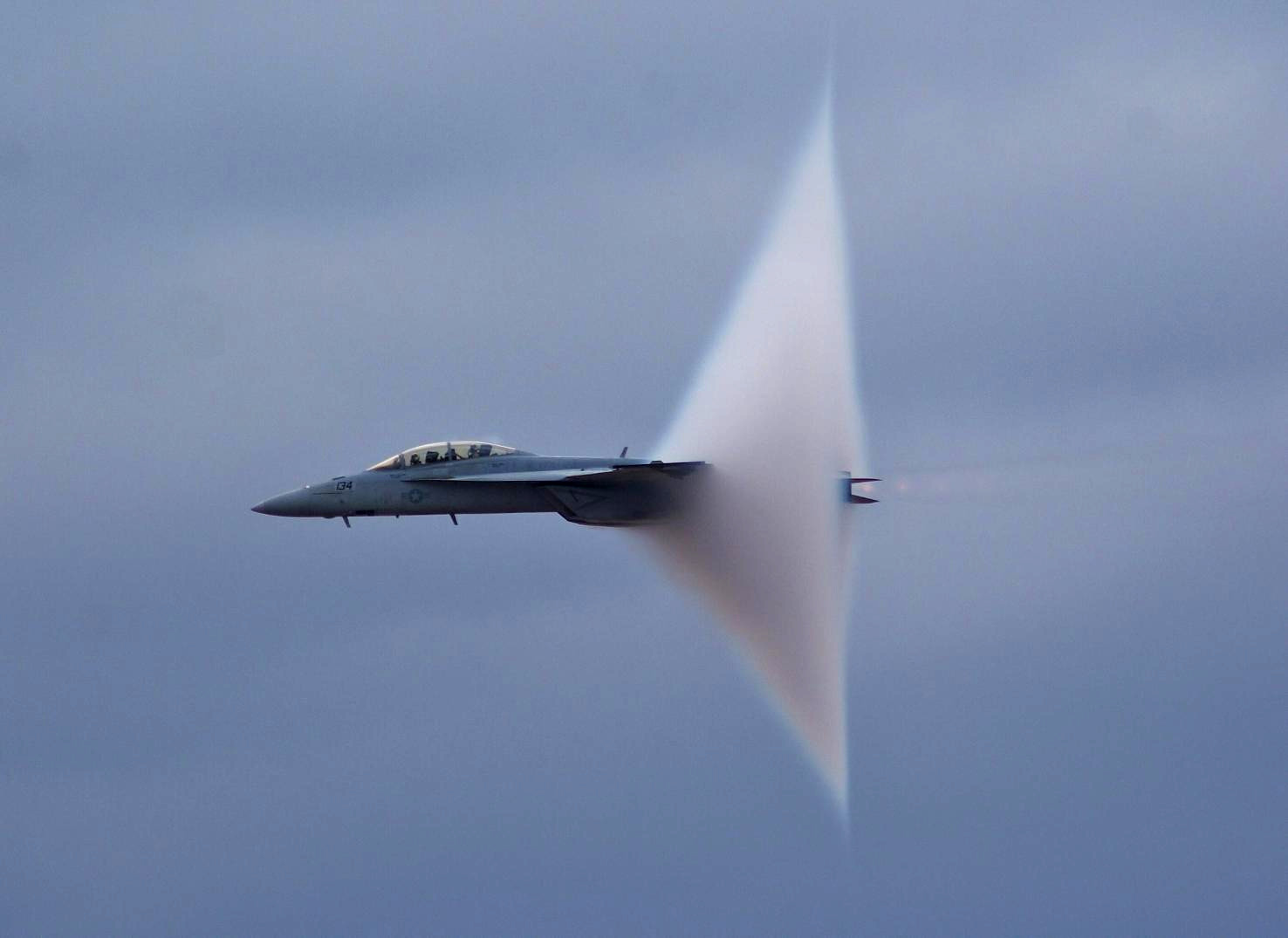 |
| Realbigtaco, "FA-18 going transonic," Wikipedia, 4 October 2008 |
Yet, he uses his lack of immunity to wind to great effect in the very first episode, when he runs against the wind of a tornado to reverse its spin.
(Not quite like Bob Seger.)
Yet, we don't question such simple things because they're part-and-parcel to the comic book world - that is, Barry gets to enjoy both the usefulness of air movement and the freedom of frictionlessness.
And, of course, he's not frictionless verses pavement, as otherwise he couldn't accelerate at all. They did, interestingly enough, give him new shoes to counteract the problem of ground resistance (yet he still runs in his street shoes fairly often, with no repeat of the problems he first faced).
All of these things I accept, because while they are wildly inconsistent with the rules they choose to follow or not follow, the one thing that is consistent is that they are all related to Barry's unusual powers. That is to say, he is a stranger in a familiar land. The Earth is still Earth, even with people with superhuman powers. Physics of the real world still work the way they normally do, only to be disrupted when a superhuman power interacts with them.
And that's the key to why I find fault with some things on the show...
Here be spoilers.

In the season finale, the team of ridiculously-intelligent "scientists" (which for some reason includes an uber-scientist who has to ask what a "singularity" is) decide it'll be a good idea to create a wormhole to send Barry back in time.
We can accept that it's possible to create a wormhole because of Barry's weird super-speed force that enables him to see the past when he's only going Mach 2.
And, in actuality, creating a wormhole is fine. We done here?
No, because sadly that wormhole has the capability of collapsing into a singularity for some reason.
So let's be clear about the science behind these two things. Black holes exist. Singularities exist. A singularity is an infinitesimally small point of matter, where all that mass is crammed into space that doesn't have any dimensions, at least not as we know them. Because there are no dimensions to the point, the density is infinite.
A singularity can be reached by an incredibly tiny amount of mass. That said, such a singularity would almost immediately destroy itself, because they eject more energy than they can consume. This is called Hawking Radiation, and it's why we work on creating microscopic black holes in real-world particle accelerators with no fear of destroying the Earth.
(Black holes can, theoretically, exist without singularities, but I'll concentrate on singularities since the show keeps referring to it as such.)
So, to be clear, a singularity the size they're dealing with is completely unimportant.
A wormhole is simply a concept that "what goes up must come down" - that is... what if a black hole didn't keep all the mass it consumed, and instead that mass fell through space and time. Somewhere in the universe, there could be a white hole - the reverse of the black hole, ejecting all that matter. Now, if that's the case, no singularity would exist in the center per se - you'd simply fall through one end and come out the other.
It's entirely possible, though, that the point in the center of the wormhole is still a singularity... that is, that you have to get crushed down to a point infinitely small before coming out the other side. Which would not make for great space travel, as you'd be a string of particles rather than a cohesive creature.
Which means that the wormhole in Barry Allen's story can't have a singularity at the center... it has to instead be an open tube... and if it's an open tube, it can't just collapse into a singularity (there's no accretion of matter, which is an absolute fundamental requirement of a singularity).
But... let's just say that somehow enough matter gets in there to form a singularity... then what?
Then it dissipates thanks to Hawking Radiation.
Ok, but what if that doesn't happen?
Now we're getting way outside of what is possible in the real world...
Let's say that Barry's speed force also enables the singularity to grow... that it's somehow a part of the singularity. Then what?
Well, now you have a big @#!$ing problem. Because if the singularity is not destroying itself by radiating off all of its mass, and it's somehow consuming mass from stuff around it (which would happen a lot slower than the TV show indicated, but who cares at this point), then it's going to eventually consume everything nearby. The entire Earth will be slowly sucked into it.
But right now, at this moment, the Earth is a WAY bigger source of gravity overall. Very close to the singularity, the singularity is a bigger source, which is why it can suck up stuff on the Earth and the rest of the Earth is fine.
But these two things are both massive and attracted to each other. What SHOULD happen next is the singularity falls to the ground (it should've started there, frankly), and it starts eating into the Earth, gobbling up mass on the way to the center of the planet.
Instead, it magically floats into the sky to start consuming the Earth from a height of about 2,000 feet above sea level.
This is also not possible...
We see then that the singularity begins developing what's called an "accretion disk." This happens because singularities are always spinning. Heck, all matter is spinning. Your own protons and neutrons and electrons are spinning.
But, as mass clumps together in the middle of that singularity, it also spins, and increases its spin rate the closer it gets to that center (the classic illustration of this is an iceskater who spins, and if he puts his arms out wide, he spins slowly, and if he pulls them in close, he spins quickly). The accretion disk is actually a bit of good science in all of this bad... the tidal forces of massive gravitational spin cause it, and things that get pulled in close to the singularity would join this accretion disk first (at varying levels).
What's not good is what the so-called "scientists" of the show decide next.
You see, you can't just let a black hole gobble up the Earth. It causes a few limitations on their ability to have a Season 2.
So, these "scientists" decide that the only way for Barry to destroy the singularity is to run in the opposite direction of its spin...
There's just so much wrong with this I can't even wrap my brain around it...
First of all, the black hole is super massive.. so massive, that it's defeating the Earth's gravity and pulling buildings apart to gobble them up. If it's that massive, then what's the mass of one human going to do?
It'd be like Barry trying to slow the rotation of the Earth by running around it the same direction as the spin (which would push force in the opposite direction of the spin). Except that in the case of the Earth, that mass is spread out over a huge area. In the case of the singularity, it's in an infinitely tiny area.
Remember your grade school experiments with simple levers? The entire reason a crow bar works, for instance, is because you're applying the force over distance - the further away from the fulcrum of a lever you are, the more force you can apply thanks to the distance. Running around the Earth would work similarly - small amounts of force applied over a huge area. Running around the singularity would require much greater speed still...
Both far more speed than Barry can generate.
But, let's say for the sake of argument that he can somehow conquer the spin of the singularity, then what?
Because there's the biggest @#!$ing problem with this whole theory... the spin is a result of the singularity, not the cause of the singularity. The mass is still present, even if the spin is gone. The moment Barry stops moving, the spin will come right back. And that spin doesn't somehow destabilize the black hole - if anything, it helps prevent it from growing faster, thanks to centrifugal force. Some objects would be thrown away rather than gobbled up.
Instead, what would really need to happen would be to in some way break up the singularity...
The only answer to which is "Hawking Radiation."
Maybe the "scientists" are hoping instead to create what's called a "naked singularity" - a situation that occurs from just the right amount of angular momentum for a black hole so that light CAN escape from the center... allowing us to see the singularity. Maybe they'll analyze it and figure out how to beat it at that point... but I'm not holding out much hope.
Monday, May 11, 2015
The Naked Truth
Here's a dangerous topic to discuss - nudity.
Dangerous because I can't really Google research on the topic without a certain expectation of getting Google Image Search results on the topic, which would certainly be a form of research (if you need a research topic with billions of primary sources, this may be the one for you), but would not exactly be what I'm trying to achieve.
That's not to say I mind naked people - quite the contrary, as a nudist I'm quite used to them. However, the images returned from such a search are not often simply naked people, and even if they were, they would not be what we lovingly refer to as "safe for work."
And that brings up an interesting problem: What is safe for work, and why? What is nudity, and why? Why do we draw lines on the human body to divide up the acceptable and the profane?
From a conservative Christian perspective, of course, the answer is easy: the world is only 6000 years old, Adam and Eve were naked in the Garden, they sinned, God made them wear clothes. The end. Of course, this simplistic understanding leaves even the 6000 years of history that the most hardcore conservatives acknowledge skipped over - that is, it disregards several historical anomalies:
So, other than comfort in mild conditions and health in extreme conditions, there's really no reason to be wearing clothes, nor any reason to be concerned about the sight of nudity in others. The sexual desire of certain parts of the body is merely a social construction, one which we can choose to deny.
Doing so would solve a commonly-listed problem fear of some people, especially those on the Right: the fear of other people using the bathroom with them just to sneak a peek at their genitals and breasts. The argument goes something like this: I'm a man, and I'm worried that another man who is gay might use the men's room next to me and leer at my penis while I'm peeing; or, I'm a man, and I'm worried that a woman might dress in men's clothing just to use the men's room and leer at my penis, etc. Same argument with genders flipped for women.
There are countries in the world where they don't worry about gender with regard to the bathroom. Even in the U.S., there's a growing trend for colleges to offer unisex bathrooms. I recall a female friend of mine confiding in me that, while on Christian mission work in Romania, she stayed in a hostel with only one set of showers that were open and unisex - meaning that everyone who showered did so in full view of everyone else. Initially she had typical American reservations about it, but the needs of getting clean after sweating through mission work necessitated using the showers, and her fears about them subsided. She discovered that there was nothing wrong with them. They were simply different.
Dangerous because I can't really Google research on the topic without a certain expectation of getting Google Image Search results on the topic, which would certainly be a form of research (if you need a research topic with billions of primary sources, this may be the one for you), but would not exactly be what I'm trying to achieve.
That's not to say I mind naked people - quite the contrary, as a nudist I'm quite used to them. However, the images returned from such a search are not often simply naked people, and even if they were, they would not be what we lovingly refer to as "safe for work."
And that brings up an interesting problem: What is safe for work, and why? What is nudity, and why? Why do we draw lines on the human body to divide up the acceptable and the profane?
From a conservative Christian perspective, of course, the answer is easy: the world is only 6000 years old, Adam and Eve were naked in the Garden, they sinned, God made them wear clothes. The end. Of course, this simplistic understanding leaves even the 6000 years of history that the most hardcore conservatives acknowledge skipped over - that is, it disregards several historical anomalies:
- The common practice in much of the Roman Empire during the first century was communal bathing. The practice is entirely unmentioned in the Bible despite discussion of other Roman practices.
- People were commonly nude for a variety of tasks, such as fishing (Peter is described as naked in some translations of John 21:7) and gardening (Karl Kästner says that the reason the women in Jesus's posse mistook him for a gardener is that he had left his garments behind in the tomb and was therefore naked, and gardeners at the time would have worked naked.).
- In first liturgy of baptism, participants were naked: "Then they shall take off all their clothes," it says, and later, "after these things, the bishop passes each of them on nude to the elder who stands at the water. They shall stand in the water naked." (source)
- European art from throughout Catholic dominance depicts people naked, especially after Europeans began studying Roman and Greek history and art. This art is often highly religious in nature, depicting stories directly from the Bible. Michelangelo's David, for instance, depicts the king of ancient Israel and Judea.
So, other than comfort in mild conditions and health in extreme conditions, there's really no reason to be wearing clothes, nor any reason to be concerned about the sight of nudity in others. The sexual desire of certain parts of the body is merely a social construction, one which we can choose to deny.
Doing so would solve a commonly-listed problem fear of some people, especially those on the Right: the fear of other people using the bathroom with them just to sneak a peek at their genitals and breasts. The argument goes something like this: I'm a man, and I'm worried that another man who is gay might use the men's room next to me and leer at my penis while I'm peeing; or, I'm a man, and I'm worried that a woman might dress in men's clothing just to use the men's room and leer at my penis, etc. Same argument with genders flipped for women.
There are countries in the world where they don't worry about gender with regard to the bathroom. Even in the U.S., there's a growing trend for colleges to offer unisex bathrooms. I recall a female friend of mine confiding in me that, while on Christian mission work in Romania, she stayed in a hostel with only one set of showers that were open and unisex - meaning that everyone who showered did so in full view of everyone else. Initially she had typical American reservations about it, but the needs of getting clean after sweating through mission work necessitated using the showers, and her fears about them subsided. She discovered that there was nothing wrong with them. They were simply different.
Monday, April 20, 2015
Acceptable Losses
I mentioned in my post about the death of Eric Harris in the Tulsa reserve-deputy-involved shooting that there was another shooting around the same time in Sand Springs.
It was of a mentally ill man named Donald Allen - "a paranoid schizophrenic who ha[d] been off his medication for a year" according to the Allen's wife (source). He was a Vietnam vet, and I don't think there's anyone in this country who doesn't agree we should be doing more for the mental health of our veterans. Yet, here he was.
He was having a breakdown, and came out from his house with a gun, charging at police. Some might call this sort of attack "suicide by police," but this seems to brush under the rug the horrible truth about it - that had we simply had better support for him in the first place, this would have been entirely avoidable.
There are a couple of key differences between this death and the death of Harris; key among them, perhaps, is the presence of a gun in the hands of Allen. Officer intent is another, and race is certainly one as well. The reason race plays into it is that black men finally - and rightfully, I might add - are having a national voice to protest police violence. It's catching our attention in a big way, and leading to small changes that will hopefully save lives. Allen, on the other hand, has no voice - while he is white, he is also a member of the Mentally Ill minority group. This group is still voiceless.
To the credit of the Sand Springs Police Department, though, they acknowledged this same problem, and admitted that our system is broken and we need to find ways of providing better assistance.
How would we avoid these deaths in the future? Well, larger cities (such as Tulsa) could and should invest in psychological task forces, given the role of handling cases where a perpetrator has a known history of mental illness and helping to identify cases of mental illness in those cases with no history. Expanded mental health care would also help, though Obamacare greatly increases it already - many people are not aware of their ability to access mental health services through their insurance, and this needs to be broadcast more.*
But as long as we continue to have a stigma surrounding mental health issues, we will continue to have people avoiding getting help. Perhaps that is why Allen was avoiding taking medication - because to take medication is to admit that you still have a problem, and most of us would like to think we've overcome our mental health issues, that they are only temporary.
So to start out, I'd like to publicly declare - I've sought mental health assistance myself, for depression and anxiety brought on by abuses I received as a teenager. My mind had reacted to those abuses by creating these two issues, which had protected it from further damage, but had left me unable to cope with certain things. I will never be *over* these issues. But I refuse to back down from them, either.
And I hope and pray that each of you who might be facing your own mental health issues will realize that you have mental health assistance through your insurance and that seeking help for it is not an admission that you are weak, but rather that you're human. And, as a human, throughout your life you've developed a toolkit for dealing with problems that arise. Some of those tools are damaging, some are healthy. A trained professional can help you develop new, healthier tools, and help you spot the ones that are damaging.
* - of course, eliminating guns would also help, as a cop doesn't need a gun in that case, either. But that'll never happen in this country, so I'm trying to be realistic.
It was of a mentally ill man named Donald Allen - "a paranoid schizophrenic who ha[d] been off his medication for a year" according to the Allen's wife (source). He was a Vietnam vet, and I don't think there's anyone in this country who doesn't agree we should be doing more for the mental health of our veterans. Yet, here he was.
He was having a breakdown, and came out from his house with a gun, charging at police. Some might call this sort of attack "suicide by police," but this seems to brush under the rug the horrible truth about it - that had we simply had better support for him in the first place, this would have been entirely avoidable.
There are a couple of key differences between this death and the death of Harris; key among them, perhaps, is the presence of a gun in the hands of Allen. Officer intent is another, and race is certainly one as well. The reason race plays into it is that black men finally - and rightfully, I might add - are having a national voice to protest police violence. It's catching our attention in a big way, and leading to small changes that will hopefully save lives. Allen, on the other hand, has no voice - while he is white, he is also a member of the Mentally Ill minority group. This group is still voiceless.
To the credit of the Sand Springs Police Department, though, they acknowledged this same problem, and admitted that our system is broken and we need to find ways of providing better assistance.
How would we avoid these deaths in the future? Well, larger cities (such as Tulsa) could and should invest in psychological task forces, given the role of handling cases where a perpetrator has a known history of mental illness and helping to identify cases of mental illness in those cases with no history. Expanded mental health care would also help, though Obamacare greatly increases it already - many people are not aware of their ability to access mental health services through their insurance, and this needs to be broadcast more.*
But as long as we continue to have a stigma surrounding mental health issues, we will continue to have people avoiding getting help. Perhaps that is why Allen was avoiding taking medication - because to take medication is to admit that you still have a problem, and most of us would like to think we've overcome our mental health issues, that they are only temporary.
So to start out, I'd like to publicly declare - I've sought mental health assistance myself, for depression and anxiety brought on by abuses I received as a teenager. My mind had reacted to those abuses by creating these two issues, which had protected it from further damage, but had left me unable to cope with certain things. I will never be *over* these issues. But I refuse to back down from them, either.
And I hope and pray that each of you who might be facing your own mental health issues will realize that you have mental health assistance through your insurance and that seeking help for it is not an admission that you are weak, but rather that you're human. And, as a human, throughout your life you've developed a toolkit for dealing with problems that arise. Some of those tools are damaging, some are healthy. A trained professional can help you develop new, healthier tools, and help you spot the ones that are damaging.
* - of course, eliminating guns would also help, as a cop doesn't need a gun in that case, either. But that'll never happen in this country, so I'm trying to be realistic.
Friday, April 17, 2015
Tulsa shooting
I'm doing this on my phone so it'll be a little light on research and punctuation.
I thought I'd throw some thoughts about the Tulsa shooting out there. The basic story goes like this - a man ran from sheriff's deputies during a sting on a gun buy. One of the officers was a reserve deputy who is a citizen volunteer with the sheriff's department. Another deputy asked the volunteer to taze the suspect after two deputies had already wrestled him to the ground. The volunteer mistook his revolver for the taser and fired a round into the suspect. The volunteer immediately apologized. The suspect complained that he couldn't breathe, and a deputy said "fuck your breath." The suspect died. The reserve deputy has been arrested and charged with manslaughter.
Where to begin...
The suspect was black and the reserve deputy was white. This could imply some racism, but I think everyone can acknowledge that the shooting was unintentional. But that's not quite right, either.
The reserve deputy DID intend to shoot the suspect - he just didn't intend to use a gun. We seem to accept the use of a taser as an acceptable way to avoid death, but the taser itself is a deadly weapon. See http://m.livescience.com/36418-tasers-kill-cardiac-arrest-stun-gun.html
All that has to happen for a stun gun to kill is for that electricity to travel through the heart. Just as it makes a subject's other muscles cease up, so to can it make the heart cease, causing cardiac arrest. A stun gun, like a bullet gun, should only be employed in an emergency, but its use by police is anything but.
It is a way of inflicting violence at a distance that tricks its wielder into a false sense of safety - and that means it still holds all of the original prejudices and animosities under its surface.
Now, I don't blame the shooter here, despite the fact that claims have been made that he lacked the requisite training. I think that's a false flag to the real problem. He did as he was told by an officer of the law, and had he not made a mistake, we'd never have heard about it.
The deputies had the suspect on the ground, face-down. Rather than let him struggle and wear himself out, they opted to deploy their taser. It was unnecessary and potentially deadly even without a mistake, and that to me means they didn't respect the life of the suspect in the first place.
They proved as much for their willful ignorance to his breathing pleas.
That's where the systemic racism lies in this case, and what we desperately need to focus on to help prevent further abuses of power by our force.
On a final side note - did anyone know that within a day a Sand Springs cop shot and killed a mentally ill man? There's a real story there, too, but we've been ignoring it.
Subscribe to:
Posts (Atom)